Buyer and owner guide · reviewed Oct 8, 2026
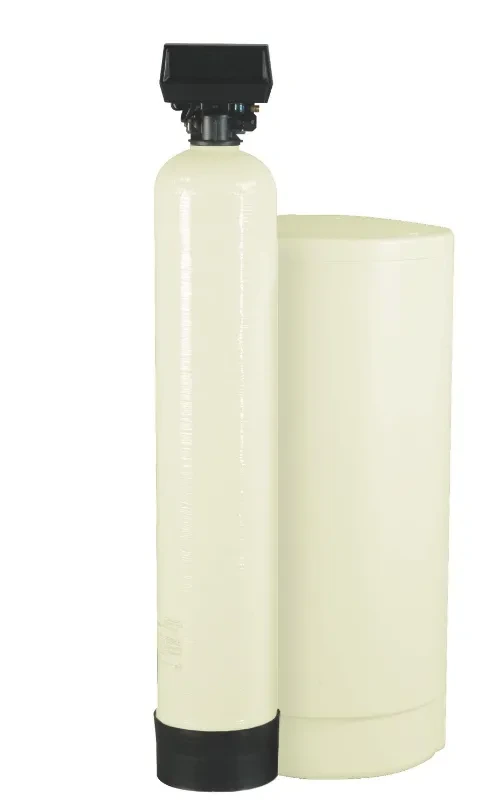
At a glance: Watts M3011-W100SM-CR-CMP combines activated carbon and ion-exchange resin in separate chambers of one mineral tank. Its full suffix distinguishes it from a plain M3011 softener. The current catalog supplies an exact dual-media row, but conflicting valve labels and absent dose-dependent capacity require confirmation before programming or sizing the supplied system.
Water System Guide is an independent research publisher, not Watts support, a dealer or an installer. This page interprets the named dual-media catalog row and keeps neighboring manual facts separate. The exact installed control, operating range, current commerce, warranty and certification scope remain unverified.
CR-CMP identifies a dual-media system, not the standard M3011
The 2026 dealer catalog, PDF page 18 / printed page 16 names M3011-W100SM-CR-CMP, ordering code 68110658, as a dual-chamber carbon/resin system. Its row lists 1 cubic foot of ion-exchange resin and 0.5 cubic foot of granular activated carbon. Keep the entire suffix on the quote, equipment label and service record.
That identity matters because the M3011-ST standard-tank webpage describes a neighboring softener, with its own flow statement. An M3011 name or a visually similar controller is not sufficient to transfer those specifications to CR-CMP. Ask the provider to identify the supplied configuration explicitly, including which chamber contains each medium. Do not substitute a plain softener specification merely because the model strings share a prefix.
Separate hardness treatment from carbon filtration
The dual-media description assigns different jobs to the media: activated carbon for chlorine/taste/odor pretreatment, and ion-exchange resin for softening. It describes separate chambers and says carbon can be replaced without replacing the resin. The physical separation is useful ownership information; it does not by itself verify every proposed treatment result.
Ask for two acceptance criteria. What hardness result will the resin deliver, and what specific filtration result is claimed for the carbon at your inlet concentration and flow? The catalog mentions iron with a pretreatment footnote, but provides no exact iron-application limit here. It is not blanket approval for a high-iron well, nor a chloramine, lead or microbiological-safety certification. A combination tank can save layout space while still requiring separately documented treatment targets and water suitability.
30,000 maximum is not a complete salt-dose schedule
The exact CR-CMP table labels its capacity 30,000 maximum. It does not pair that figure with a salt dose, reserve allowance or exact installed-control program. Use it as the published row’s maximum, not as guaranteed usable capacity between every regeneration.
The WM100SM manual’s quick-reference table includes plain M3011-W100SM softeners, not this dual-media suffix. Its salt-dose/capacity rows must not be silently assigned to CR-CMP. For a meaningful sizing discussion, provide measured untreated hardness, expected daily treated use and simultaneous demand. Have the installer supply the exact configuration’s dose-dependent capacity and reserve rules before calculating regeneration frequency or annual salt cost. A hypothetical daily hardness load can frame a question; without that matched capacity evidence, dividing 30,000 by the load would imply more certainty than the sources establish.
Read the flow and drain row together
The CR-CMP flow-and-pressure columns list 12–16 gpm service, 15–25 psi pressure drop and 2.7 gpm backwash. The row does not provide a full curve or state which flow maps to each loss value. Do not treat 16 gpm at the lowest pressure drop as a documented pairing, and do not borrow a valve-alone rating as complete-system treatment performance.
Ask how the proposed flow preserves the carbon treatment target and what pressure remains after the entire installation. Regeneration/backwash also needs an appropriate water supply and drain arrangement. Have the installer document the matched drain flow control, drain route and applicable requirements rather than selecting a drain from a neighboring unit’s manual. If the proposal changes the valve or media, request revised exact-system evidence instead of assuming this row still applies unchanged.
Resolve W100 versus CK-10 before using button instructions
There is a source conflict on the same catalog page: its heading, model name and footnote refer to W100, while the specifications box labels a CK-10 metered valve. This page records that inconsistency rather than deciding which head or firmware a delivered unit uses.
The captured operating manual is titled for the WM100SM valve. It is useful evidence about that manual’s scope, not proof that every CR-CMP has that control or its exact mixed-media programming. Request the valve label, display/software identification and the complete-system setup document. Until matched, do not copy a generic reset, salt-dose setting, regeneration button sequence or parts list from a plain W100 or CK-10 guide. An owner can record the displayed information and symptoms without changing an uncertain program.
A single mineral tank still needs space for brine and service
The exact installation-size row lists a 10 × 54-inch mineral tank, an 18 × 36-inch brine tank, a 1-inch pipe size and 110 lb shipping weight. These are catalog component/shipping figures, not a finished footprint, full operating weight or assured clearance plan. The 350 lb salt-fill column is a tank-capacity figure, not an instruction to add that quantity at every refill.
Have the installer account for the actual head, bypass, fittings, wall clearances, drain and brine connections, support and access for future carbon work. The page’s specifications box lists standard electrical requirements as 120 volt/60 Hz; obtain the supplied power/control match rather than assuming the neighboring manual resolves all operating limits. A compact design still needs space to isolate, inspect and service both treatment functions.
Regeneration and carbon replacement are different work
The separate-chamber service description says carbon can be replaced without replacing the resin. It does not specify the interval, method or exact replacement carbon for your supplied configuration. A resin regeneration cycle is not evidence that exhausted carbon filtration has been restored.
Keep separate records for salt/refill and regeneration history, inlet/outlet hardness, the proposed carbon target, media replacement and service. If hardness rises while taste remains acceptable, or vice versa, explain which observation changed to the service provider. Request the exact replacement-media identity, who performs the work, what is isolated and how the claimed treatment result is checked afterward. For unresolved hardness symptoms, the Watts troubleshooting guide explains the controller-match boundary and a useful owner record; it does not authorize unverified CR-CMP programming.
Ask the supplier to close the exact-system evidence gaps
The named CR-CMP catalog row is a sound starting identity, but it does not settle every purchase or installation question. Request a current exact-system specification, operating range, matched valve/control instructions, dose-dependent softening capacity, carbon performance evidence and replacement/service plan.
Compare those items before comparing the price of CR-CMP with a plain softener or separate filter/softener pair. Record included equipment, installation work, recurring media work and any unresolved source conflict in the written quote. Current price, stock, local service, certification scope and warranty entitlement remain unverified here. A family webpage, component logo or shared manual cannot substitute for the documents applying to the actual mixed-media equipment.
Frequently asked questions
What makes M3011-W100SM-CR-CMP different from a plain M3011 softener?
The exact catalog row identifies a dual-chamber system with 1 cubic foot of ion-exchange resin and 0.5 cubic foot of activated carbon. Keep the CR-CMP suffix when matching specifications, controls and service parts.
Can I program CR-CMP using the plain M3011-W100SM salt table?
The captured manual’s plain M3011-W100SM table does not establish the CR-CMP mixed-media program. Obtain the exact installed-control instructions and dose-dependent capacity rather than transferring the neighboring rows.
Does this record prove a W100 or CK-10 controller?
The catalog page conflicts: its name, heading and footnote say W100, while the specification box says CK-10 metered valve. Match the actual label, firmware and complete-system instructions before changing settings.
Does regeneration renew the carbon as well as the resin?
The catalog separates carbon and resin and says carbon can be replaced without replacing resin. It does not establish a carbon replacement interval; a resin regeneration is not proof that exhausted carbon filtration has recovered.
Related guides
Sources for this model guide
- Watts 2026 dealer catalog, exact dual-media M3011-W100SM-CR-CMP row — C-WQ-Dealer2604 ©2026; reviewed 2026-10-08.
- Watts WM100SM operating manual; neighboring plain-softener scope — Undated manual; Form0500-200/P-N XOSW100SM; reviewed 2026-10-08.
- Watts M3011-ST standard-tank family webpage; captured reader bundle — Undated standard-tank family webpage, not exact dual-media CR-CMP; reviewed 2026-10-08.
Known product details
- Manufacturer
- Watts
- Model or family
- M3011-W100SM-CR-CMP
- Catalog name
- Watts M3011-W100SM-CR-CMP
- Product category
- Water softener
- Product family
- Water Softeners
- Historical equipment price
- No current verified price; equipment and installed-scope pricing require current confirmation.
- Source reviewed
- 2026-08-16
Evidence and source boundary
Price and availability notes are historical source records, not live offers or stock checks. After any stated verification expiry, obtain a new seller check before relying on the value.
Manufacturer catalog presence was observed in the pinned source workbook. Current stock, dealer authorization, installation scheduling, and address-level service are not verified.
The controlling source for this catalog observation is watts.com, reviewed on 2026-08-16. A manufacturer page may change, redirect, or describe a family rather than every configuration; compare the exact current documentation before purchase.
What still needs confirmation
- Certification: verify the exact model number, contaminant or reduction claim, standard, listing scope, and current certificate.
- Sizing: match household demand, flow, plumbing, pressure, water chemistry, and waste/discharge requirements.
- Ownership: confirm current equipment price, installation scope, consumables, maintenance intervals, warranty conditions, and service access.
- Availability: manufacturer catalog presence does not establish current stock, dealer authorization, installer capability, or local availability.
How to use this record
- Copy the exact model or family name shown above.
- Open the cited manufacturer source and confirm that the current page still matches.
- Request the current model-specific specification sheet, certification listing, warranty, and installed-scope quote.
- Use water evidence and site constraints before comparing this product with alternatives.