Buyer and owner guide · reviewed Oct 7, 2026
At a glance: HALO H5-100 filters and conditions water without removing hardness by ion exchange. Its one-million-gallon figure is based on chlorine reduction at 1 ppm incoming chlorine. Use the exact model, water conditions and operating requirements to assess the proposal; a hard-water test alone does not show failure.
Water System Guide is an independent research publisher. This model-specific document review was completed October 7, 2026. It is not a household performance test, installer quote or confirmation of current warranty, stock or certification records.
What H5-100 treats, and what it does not
H5-100 is the 1-inch HALO 5 filtration and conditioning configuration. Its treatment train combines carbon and sediment-filtering media with HALO ION conditioning. It does not have the ion-exchange resin and salt regeneration of a CK10 softener. The manufacturer's HALO 5 product description and hardness-test FAQ distinguish those jobs: minerals remain in conditioned water, so a hardness reading alone cannot determine whether H5-100 is working.
Choose the question before choosing a test. A chlorine or taste complaint concerns filtration. A deposit complaint concerns the documented conditioning application. A requirement for lower measured calcium and magnesium calls for actual softening. If the installation includes a separate CK10, identify both tanks on the invoice and test each intended outcome separately. A bundle name does not turn the H5-100 tank itself into a salt softener.
The one-million-gallon figure has a stated basis
The H5-100 row in the HALO 5 specification, page 2 lists 1,000,000 gallons, with a footnote specifying chlorine reduction at 1 ppm incoming chlorine. This is filtration capacity under the manufacturer's stated basis, not grain capacity, a hardness-removal rating or a guaranteed ten-year life in every home. H5-125 and H5-150 have different published capacities; their figures should not be copied onto this model.
For a proposal, record the supplied model, water use and inlet disinfectant conditions. Ask how the seller applied the stated basis to your supply and how a change will be recognized. The H5-100 end-of-life FAQ identifies treated-water chlorine detection after approximately one million gallons as a service indicator. Compare inlet and treated samples from identified points with an appropriate test. That indicator does not prove that every other advertised contaminant is absent.
Plan around the complete H5-100 installation
The exact H5-100 specification row lists a 10 × 54-inch tank, 61-inch system height, 10-inch width and depth, 93-pound weight and 1-inch inlet/outlet. Tank height and assembled height are different measurements. Have the installer allow additional room for fittings, the controller, bypass operation and future tank access; the table does not draw the complete installed plumbing footprint.
That one-inch connection is not a verified treatment flow rating. The reviewed model table does not provide a model-specific service-flow number, so this page does not infer one from pipe size or from the larger HALO 5 models. Give the installer your simultaneous uses, such as showers and laundry, and ask for the sizing evidence and expected pressure behavior at that demand. Drain capacity during backwash is another question, separate from the flow delivered to household fixtures.
Check the water source before assuming suitability
The specification qualifications describe potable municipal-water treatment, cold-water use and an 80 psi maximum. The installation guide, page 3 gives a 25–80 psi range and requires protection from freezing. A well-water installation needs a current water analysis reviewed by HALO; an equipment listing alone is not a well-water treatment design.
HALO says conditioning results may vary above 25 grains per gallon. This is a qualification on the manufacturer's conditioning claim, not a promise that hardness below that number will disappear. Provide the actual hardness result and units, along with the water source and the concern being treated. The sheet also excludes use with microbiologically unsafe or unknown-quality water without adequate disinfection. A filtration-and-conditioning tank does not settle a drinking-water safety question merely because it is installed at the main.
Read the five stages and certification scope separately
The HALO 5 sheet, page 1 identifies GAC, catalytic HAC, Filter-AG Plus, high-density garnet and HALO ION. The carbon stages are described for filtration, AG Plus for suspended matter and garnet for filtration/support; HALO ION is the conditioning component. Those are manufacturer descriptions of the treatment train, not measurements from this home or independent proof of every advertised reduction.
The same sheet describes WQA NSF/ANSI/CAN 61 material-safety and 372 lead-free scope, then explicitly says the HALO 5 series is not WQA tested or certified for contaminant reduction, performance or structural integrity. It also distinguishes components used within the series from a standalone HALO ION device. Ask for the exact current system record and performance evidence for the particular substance of concern. This page does not add a certification claim to the catalog record.
Salt-free operation still includes a powered backwash
H5-100 needs a drain and powered controller even though it needs no salt bags. The matched HALO 5 guide, pages 3 and 6 describes a ten-minute automatic cycle and depicts SET, up-arrow and down-arrow controls. CK10 instructions using NEXT, SET CLOCK and REGEN belong to a different controller; do not transfer them to this head.
The guide's overview and backwash FAQ describe weekly operation, while the detailed programming page recommends 11 days for one person, nine for two or three, and seven for four or more. Ask which interval was commissioned for this installation. That difference is a reason to retain the installer record, not to change menus experimentally. After an outage, compare the displayed clock with the time. Photograph any error or persistent drain discharge and obtain the matching service instructions.
Ask for an H5-100 acceptance record
The installation and charging instructions, pages 4–7 require flushing and commissioning; the installation overview calls for inlet/treated chlorine checks. Have the installer record the model and serial number, controller identification, completed flush, selected backwash schedule, leak check and actual test locations. Ask whether the cold fixture used for the treated sample really lies downstream of the tank.
Keep the original results and test method for a later comparison. A change in taste deserves a matching filtration investigation, while an unchanged hardness strip is expected with conditioning alone. Record new pressure complaints, missed observed cycles and any plumbing changes separately. The purpose is to give service a reproducible change to investigate rather than using one vague symptom to order carbon, a valve or a replacement system. Commissioning and internal repairs need the matched procedure and qualified installation work.
What to put in the ownership quote
Use the model, conditional capacity and service requirements in the H5-100 sheet and installation guide to request a complete quote: equipment, plumbing, drain/electrical preparation, commissioning, future media work and labor. Ask who services this exact model at your address and how the filtration target will be checked during a complaint. Manufacturer catalog presence does not verify local stock, installer authorization or an appointment.
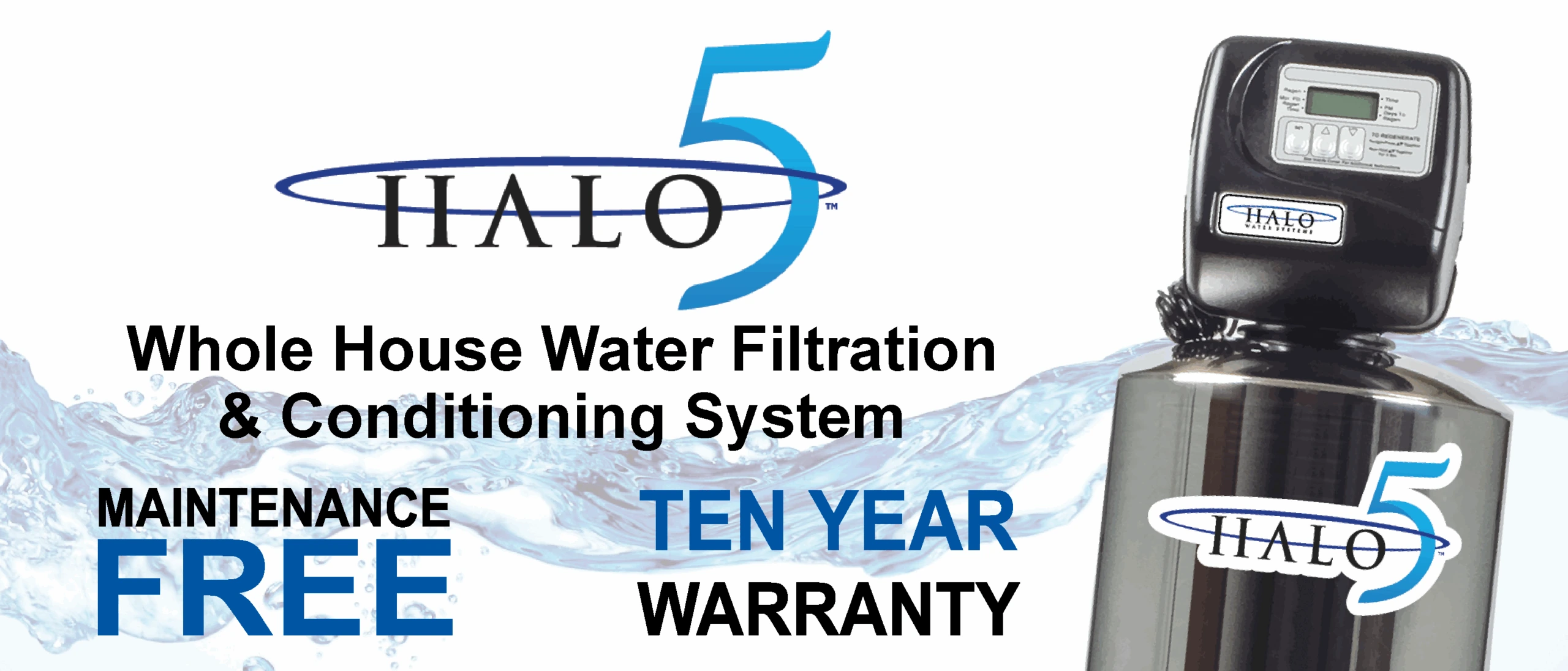
A maintenance-free headline does not mean no automatic backwash, no power requirement, indefinite carbon life or no response to a leak. Keep the invoice, supplied manual, test results and any warranty document together. Current equipment prices, legal warranty terms, exact certification records and local service charges are not verified here. For ongoing observation details use our HALO 5 maintenance guide; this model page supplies the H5-100 specification and proposal context rather than a duplicate programming or repair walkthrough.
Frequently asked questions
Does HALO H5-100 remove hardness?
H5-100 filters and conditions water without ion-exchange hardness removal. Hardness minerals remain, so a hard-water reading alone does not establish failure. A separate salt softener is a different treatment stage.
What does the H5-100 one-million-gallon capacity mean?
The HALO 5 specification lists one million gallons for H5-100 based on chlorine reduction at 1 ppm incoming chlorine. It is not grain capacity or a guaranteed ten-year lifespan for every water supply and household.
Is the one-inch H5-100 connection a service-flow rating?
No. The reviewed H5-100 table lists a one-inch inlet and outlet but does not provide a model-specific service-flow rating. Have the installer document sizing for simultaneous demand and expected pressure behavior.
Does salt-free H5-100 operation still need backwashing?
Yes. The matched guide describes a powered ten-minute automatic cycle and a drain. Its overview says weekly operation, while detailed programming recommends intervals of 7, 9 or 11 days by household size; confirm the commissioned schedule.
Related guides
Sources for this model guide
- HALO 5 manufacturer specification — Rev.3326 filename; copyright2024 in document; reviewed 2026-10-07.
- HALO 5 manufacturer installation guide — Rev.3326 filename; undated body; reviewed 2026-10-07.
- HALO 5 manufacturer product page — Undated current product page; reviewed 2026-10-07.
- HALO manufacturer frequently asked questions — Undated current FAQ page; reviewed 2026-10-07.
Known product details
- Manufacturer
- HALO
- Model or family
- H5-100
- Catalog name
- HALO 5 Whole House Filtration & Conditioning H5-100
- Product category
- Whole-home filtration
- Product family
- HALO 5
- Historical equipment price
- No current verified price; equipment and installed-scope pricing require current confirmation.
- Source reviewed
- 2026-08-16
Evidence and source boundary
Price and availability notes are historical source records, not live offers or stock checks. After any stated verification expiry, obtain a new seller check before relying on the value.
Manufacturer catalog presence was observed in the pinned source workbook. Current stock, dealer authorization, installation scheduling, and address-level service are not verified.
The controlling source for this catalog observation is halowater.com, reviewed on 2026-08-16. A manufacturer page may change, redirect, or describe a family rather than every configuration; compare the exact current documentation before purchase.
What still needs confirmation
- Certification: verify the exact model number, contaminant or reduction claim, standard, listing scope, and current certificate.
- Sizing: match household demand, flow, plumbing, pressure, water chemistry, and waste/discharge requirements.
- Ownership: confirm current equipment price, installation scope, consumables, maintenance intervals, warranty conditions, and service access.
- Availability: manufacturer catalog presence does not establish current stock, dealer authorization, installer capability, or local availability.
How to use this record
- Copy the exact model or family name shown above.
- Open the cited manufacturer source and confirm that the current page still matches.
- Request the current model-specific specification sheet, certification listing, warranty, and installed-scope quote.
- Use water evidence and site constraints before comparing this product with alternatives.